When photographers think about improving their lighting, they often focus on the obvious things: the time of day, the weather, or whether they should use a flash.
But there’s another source of beautiful light hiding in plain sight.
Reflected light.
Once you learn to recognize it, you’ll start seeing opportunities everywhere—and many of your photos will instantly look softer, brighter, and more professional without buying a single piece of gear.
Related reminder: only a little while left for the Lighting Cheat Sheets ☀️ Sunlight Sale

Photo captured by Elist Nguyen
What Is Reflected Light?
Reflected light is exactly what it sounds like: sunlight or ambient light that bounces off another surface before reaching your subject.
That surface could be:
- A white wall
- A concrete sidewalk
- A sandy beach
- A light-colored building
- Snow
- A large window
- Even a white shirt worn by someone standing nearby
- Or in this example, a field of white flowers
Instead of harsh, direct sunlight, your subject is illuminated by softer, more flattering light that has already been scattered by another surface.
It’s nature’s reflector.

Why It Looks So Good
Direct sunlight creates strong shadows and high contrast.
Reflected light, on the other hand, spreads out before it reaches your subject. The result is:
- Softer shadows
- More even skin tones
- Better detail in highlights and shadows
- A more natural, professional look
Portrait photographers often spend money on large reflectors to achieve this effect.
Outdoors, the environment is already full of them—you just need to know where to look.
Start Looking at the Ground
One of the easiest ways to find reflected light is to stop looking only at your subject.
Instead, look at what’s surrounding them.
A bright concrete sidewalk can bounce a surprising amount of light upward, naturally filling in shadows beneath a person’s eyes and chin.
A white patio or light-colored pavement can create the same effect.
Even a sandy beach acts like a giant reflector, which is one reason beach portraits often have such soft, glowing light.
Buildings Can Become Giant Light Sources
Imagine someone standing next to a large white building on a sunny afternoon.
The side of the building facing the sun becomes an enormous reflector, bouncing soft light back onto your subject.
This works especially well in cities where light-colored walls, storefronts, and office buildings create beautiful reflected light throughout the day.
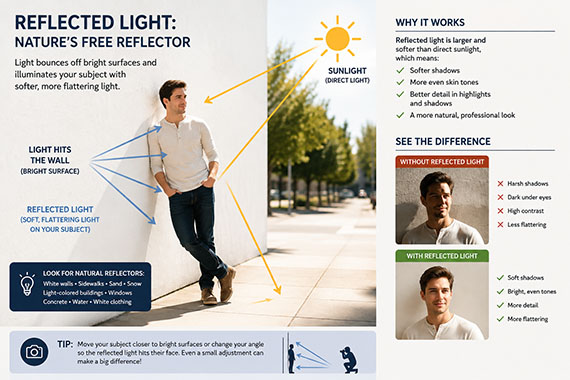
If you’ve ever wondered why one side of a street produces much nicer portraits than the other, reflected light is often the reason.
Window Light Is Reflected Light Too
Many photographers think window light comes directly from the sun.
In reality, that’s often not the case.
Most of the time, the light entering a window is actually coming from the bright sky, clouds, nearby buildings, or the ground outside. By the time it reaches your subject, it has already been scattered and softened.
That’s why window portraits often have such pleasing, even lighting.
Train Yourself to Spot Reflectors
The next time you’re walking around with your camera, ask yourself:
- What bright surfaces are nearby?
- Which direction is the light bouncing?
- Could I move my subject closer to that wall or sidewalk?
- Would turning them a few degrees improve the reflected light?
These questions take only a few seconds but can dramatically improve your photographs.
Try This Simple Experiment
Find a white wall outside on a sunny day.
Take one portrait several feet away from the wall.
Then move your subject close to the wall while keeping the same camera settings.
You’ll likely notice that the second image has softer shadows, brighter eyes, and much more flattering light—even though the sun hasn’t changed.
The wall did all the work.
Final Thoughts
Many photographers spend years chasing perfect golden-hour conditions while overlooking the incredible light that’s already surrounding them.
The next time you’re out shooting, don’t just look at the sky.
Look at the sidewalks.
Look at the walls.
Look at the sand, the snow, the windows, and the buildings around you.
Once you start noticing reflected light, you’ll discover beautiful lighting opportunities almost everywhere—and you’ll begin creating stronger photographs no matter what time of day you’re shooting.
For Further Training:
Lighting is arguably the most important aspect of photography; but do you know how to use it? These Photography Lighting Cheat Sheets are designed to help. With critical information on ALL the types of natural light and artificial light you can use. They are currently 80% off today for a Sunlight Sale ☀️
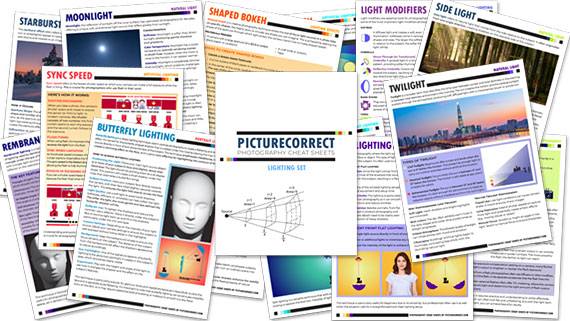
New! Cheat Sheets for Photography Lighting (see how they work)
Whether you’re a seasoned professional or just starting out, photography cheat sheets can be a valuable resource for improving your skills and taking your photography to the next level. By having all the key information you need in one place, you can focus on what’s important – capturing amazing photos.
Sunlight sale ending soon: Photo Lighting Cheat Sheets at 80% Off
Like This Article?
Don't Miss The Next One!
Join over 100,000 photographers of all experience levels who receive our free photography tips and articles to stay current:




Leave a Reply