Landscape photographers often want the same thing: sharp detail from the foreground all the way to the horizon.
Two techniques can get you there—hyperfocal distance and focus stacking—but they work very differently.
Quick reminder: Our top deal of the month ends tomorrow. There’s just 1 day left to get the Tack Sharp Photography Guide at 70% Off
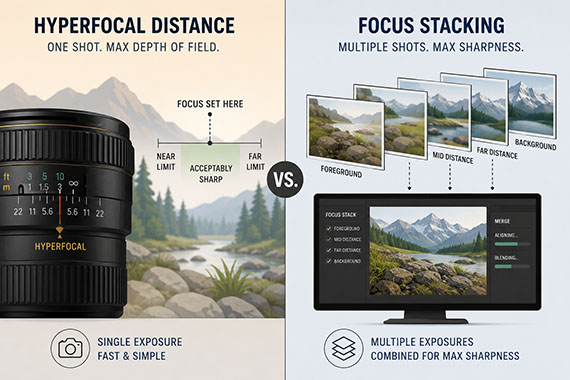
Hyperfocal Distance: The Single-Shot Solution
Hyperfocal focusing means focusing at a distance that gives you the greatest usable depth of field, rather than simply focusing on the background.
With the right focal length and aperture—often around f/8 to f/11—you can keep much of the scene acceptably sharp in a single exposure.
It’s especially useful when:
- The scene contains moving water, clouds, or foliage
- You’re shooting handheld
- You need to work quickly
- The foreground isn’t extremely close
The key word, however, is acceptably sharp. Objects near the limits of your depth of field aren’t actually in perfect focus.
Focus Stacking: Maximum Sharpness
Focus stacking takes a different approach.
You capture several photographs while moving the focus point through the scene:
Foreground → Middle Distance → Background
The sharpest portions of those images are then blended together in software.
Because each part of the scene gets its own focused exposure, focus stacking can produce better edge-to-edge sharpness than hyperfocal focusing.
It’s particularly useful when something important is very close to your lens—such as flowers or rocks—while the background extends to infinity.
You can also shoot around f/8 rather than relying on f/16 or f/22 for extra depth of field, helping avoid sharpness loss from diffraction.
So Which Is Better?
Use hyperfocal distance when you want simplicity, need a single exposure, or have movement in the scene.
Use focus stacking when the camera is on a tripod, the scene is relatively still, and maximum sharpness from foreground to background is the priority.
There’s one easy rule to remember:
Hyperfocal distance gives you more acceptable sharpness in one shot. Focus stacking gives you maximum sharpness across multiple shots.
Neither technique is always better.
But when you have an extremely close foreground combined with a distant background, focus stacking is often the technique that can take your landscape sharpness to the next level.
For Further Training:
If you’re ready to stop guessing why your photos aren’t sharp, our new Tack Sharp Photography Guide (currently 70% off until the end of the month for a ☀️ Summer Sale) will walk you through the complete system for capturing consistently crisp images.
Inside, you’ll learn how to choose the right camera settings, master autofocus, eliminate camera shake, maximize lens sharpness, develop an efficient editing workflow, and prepare your photos for stunning prints. Whether you shoot landscapes, wildlife, travel, portraits, macro, or sports, the techniques apply to virtually every style of photography.
Only 1 day left: The Tack Sharp Photography Guide at 70% Off
Like This Article?
Don't Miss The Next One!
Join over 100,000 photographers of all experience levels who receive our free photography tips and articles to stay current:





Leave a Reply