Most photographers assume their most expensive lens is also their sharpest.
Or maybe it’s the newest lens. The prime lens. The one with the biggest front element and the impressive-looking red or gold ring.
But if you actually test the lenses in your camera bag, you might be surprised.
The lens that produces your sharpest photographs isn’t necessarily the lens with the best reputation—or even the highest price tag.
Sharpness Depends on More Than the Lens
When lens manufacturers and review sites measure sharpness, they’re usually testing under carefully controlled conditions.
Real photography is different.
Your results depend on several factors working together:
- Aperture
- Focal length
- Focus accuracy
- Shutter speed
- Camera resolution
- Subject distance
- Technique
A lens that looks spectacular on a test chart at f/5.6 might not be the lens that gives you the sharpest results in the field.
Your Zoom Lens May Beat Your Prime
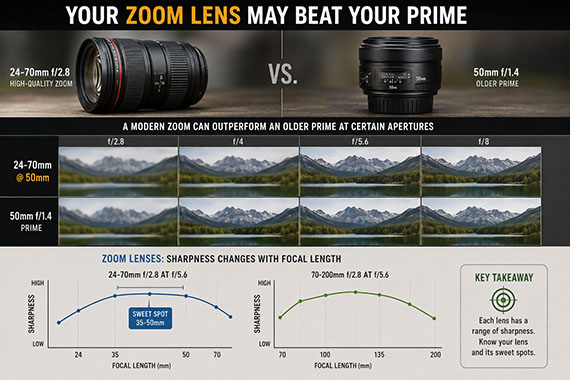
There’s a long-standing photography rule that prime lenses are sharper than zooms.
That was often true in the past, but modern lens design has made the difference much less predictable.
A high-quality 24–70mm or 70–200mm zoom can sometimes outperform an older prime lens—especially at certain apertures.
And zoom lenses have another wrinkle:
Sharpness can change depending on the focal length.
Your 24–70mm might be exceptionally sharp around 35–50mm but slightly softer at 24mm. Your 70–200mm might perform differently at 70mm than it does at 200mm.
In other words, you don’t really have one lens sharpness level.
You have a range of them.
Every Lens Has Its Own Personality
Try photographing the same detailed subject with several of your lenses.
Use a tripod, keep ISO low, focus carefully, and compare the images at similar focal lengths and apertures when possible.
Pay particular attention to:
The center: Which lens resolves the finest details?
The corners: Does sharpness fall apart near the edges?
Wide open: How much does the lens improve when you stop down?
Mid-range apertures: Many lenses reach peak performance somewhere around f/4 to f/8, although there is no universal “sweet spot.”
You may discover that the inexpensive lens you’ve owned for ten years is remarkably sharp at f/5.6.
Meanwhile, your expensive fast lens might only become exceptionally crisp after stopping down a little.
There’s Another Factor Most Photographers Forget
Your individual copy of the lens matters too.
Manufacturing tolerances mean two examples of the exact same lens model aren’t necessarily perfectly identical. Small differences in optical alignment or autofocus performance can affect real-world results.
That’s why online sharpness rankings only tell you so much.
What really matters is:
Which lens produces the best results on your camera?
And there’s only one reliable way to find out.
Test it.
A Simple 15-Minute Lens Test
Pick a detailed, stationary subject—a brick wall, newspaper, bookshelf, textured building, or landscape with plenty of fine detail.
Put your camera on a tripod and photograph it with each lens.
For each lens, shoot several apertures:
Wide open → f/4 → f/5.6 → f/8 → f/11
Then inspect the files at 100%.
You’re not trying to conduct a laboratory test.
You’re simply learning where each lens performs best.
You might come away with useful notes like:
“My 50mm is slightly soft at f/1.8 but fantastic by f/2.8.”
Or:
“My 24–70mm is surprisingly sharp around 35mm at f/5.6.”
Those observations are far more useful in the field than knowing which lens scored highest on somebody else’s test chart.
Know Your Gear, Not Just Its Specs
Sharp photography isn’t about owning the lens with the highest price tag.
It’s about understanding where your equipment performs at its best.
Once you know the strongest focal lengths and apertures for the lenses you already own, you can deliberately use those combinations when maximum detail matters.
And you may discover something surprising:
Your sharpest lens might already be sitting in your camera bag—you just haven’t been using it at its best.
Like This Article?
Don't Miss The Next One!
Join over 100,000 photographers of all experience levels who receive our free photography tips and articles to stay current:




Leave a Reply