If you’ve ever photographed stars, the Milky Way, or a distant landscape, you’ve probably heard this advice:
“Just set your lens to infinity.”
It sounds simple. Turn the focus ring to the ∞ symbol and distant subjects should be perfectly sharp.
Except that’s often not what happens.
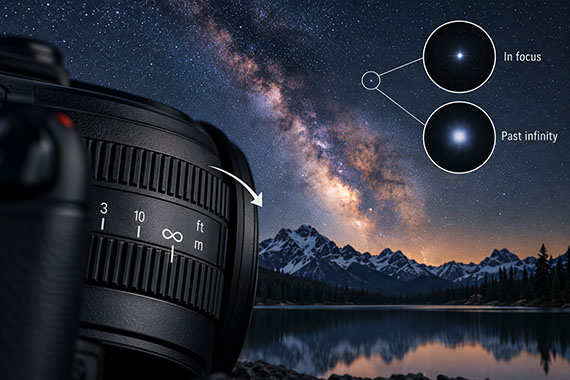
Many Lenses Focus Past Infinity
In photography, “infinity” doesn’t literally mean an infinitely distant object. It describes a distance where incoming light rays are effectively parallel enough that increasing the subject distance requires almost no change in focus.
A distant mountain, the Moon, and a star light-years away can therefore require essentially the same lens position.
But here’s the surprising part:
The end of your focus ring may actually be beyond infinity.
Manufacturers often allow extra focusing travel to accommodate things like temperature changes, manufacturing tolerances, and autofocus operation. Modern focus-by-wire lenses can make the relationship between the focus ring and actual lens position even less predictable.
So simply turning your focus ring all the way to the stop can actually make distant subjects slightly blurry.
Even the ∞ Mark Isn’t Always Exact
The infinity symbol itself shouldn’t necessarily be treated as a precision calibration.
Small differences in lens design, temperature, focal length, and calibration can change exactly where optimal infinity focus occurs.
This becomes especially noticeable in astrophotography.
A tiny focusing error that’s almost invisible in a daytime landscape can turn stars from sharp points into tiny blurry circles.
How to Find True Infinity Focus
Instead of trusting the focus ring, verify focus visually.
For Milky Way or star photography:
- Switch to manual focus.
- Open your aperture wide.
- Find a bright star using Live View or your camera’s display.
- Magnify the image as much as practical.
- Slowly rotate the focus ring.
Watch the star carefully.
As you approach correct focus, it should become smaller and sharper. Keep turning and you’ll often see it begin getting larger again.
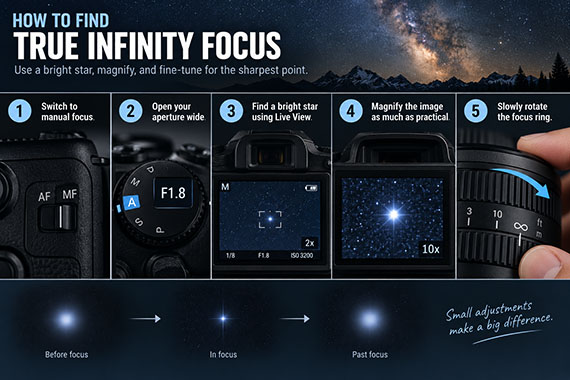
The point where the star appears smallest is your true infinity focus.
Interestingly, that position may be slightly before the ∞ mark—or before the end of the focus ring.
Infinity Focus Can Move
There’s one more complication.
Temperature changes can slightly alter the optical dimensions of a lens. During a long, cold astrophotography session, the perfect infinity position can therefore shift.
That’s why it’s worth checking focus occasionally throughout the night rather than assuming it will remain perfect.
Once you’ve nailed focus, you can also place a small piece of removable tape across the focus ring to prevent accidentally moving it.
The Bigger Lesson
The ∞ symbol doesn’t really mean:
“Everything distant will be perfectly sharp here.”
It’s better interpreted as:
“Infinity focus should be somewhere around here.”
For ordinary photography, the difference may be insignificant. But for stars, the Milky Way, and other subjects where precise focus matters, don’t blindly trust the symbol.
Magnify the image, fine-tune the lens, and trust what you see.
Because when it comes to lenses, infinity isn’t always where you think it is.
Don’t Miss the Last Milky Way Opportunity of the Season:
If photographing the Milky Way has been sitting on your summer photography list, September is giving you one more excellent opportunity.
The new moon arrives on September 10, 2026, creating several evenings with very little moonlight to interfere with the night sky. For photographers across much of the Northern Hemisphere, this is also one of the last really convenient opportunities of the summer to photograph the bright Galactic Core.
Like This Article?
Don't Miss The Next One!
Join over 100,000 photographers of all experience levels who receive our free photography tips and articles to stay current:






Leave a Reply