Every October, Earth passes through debris left behind by Halley’s Comet, creating one of autumn’s most interesting night sky events: the Orionid meteor shower.
This year’s shower peaks around October 21–22, 2026, with approximately 10–20 meteors per hour possible under ideal dark skies.
There’s one challenge this year: a bright Moon will make fainter meteors difficult to see. Your best opportunity will be during the early morning hours, particularly after the Moon sets.
Related: deal ending soon for the Milky Way Photo Guide 🌙 Clear Skies Sale
Best Camera Settings for the Orionids
You don’t need specialized equipment. A DSLR or mirrorless camera, wide-angle lens, and sturdy tripod are ideal.
Try these starting settings:
- Shooting Mode: Manual
- Aperture: f/1.8–f/2.8
- Shutter Speed: 10–20 seconds
- ISO: 1600–6400
- Lens: 14–24mm wide-angle (full-frame equivalent)
- Focus: Manual, focused on a bright star
- File Format: RAW
- Drive Mode: Continuous interval shooting
Adjust your exposure based on sky brightness and your camera’s capabilities.
Where Should You Point Your Camera?
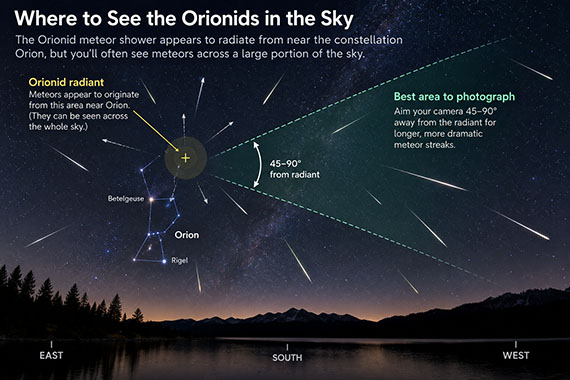
The Orionids appear to originate near the constellation Orion, but here’s a little-known photography trick: don’t point your camera directly at Orion.
Meteors photographed farther from the shower’s radiant often produce longer, more dramatic streaks. Try aiming approximately 45–90 degrees away from Orion.
Including a mountain, tree, or other interesting foreground can make your photograph even more compelling.
The Secret: Keep Shooting
Meteor photography is largely a numbers game. You never know exactly when or where a shooting star will appear.
Set your camera to take continuous 15-second exposures using an intervalometer. Over two hours, you could capture hundreds of photographs, dramatically increasing your chances of catching a meteor.
Important tip: Turn off long-exposure noise reduction if your camera pauses after each photograph to process a dark frame. Otherwise, you could miss half the action!
A Few Final Tips
- Escape city lights. Dark skies make faint meteors much easier to capture.
- Focus carefully. Magnify a bright star in live view and manually focus until it’s sharp.
- Bring extra batteries. Long shooting sessions can drain them quickly.
- Check every frame. Some meteors are easy to overlook on your camera’s small screen.
If you capture several meteors from the same location, you can even combine the photographs into a dramatic composite image.
The Orionids offer a special opportunity to photograph tiny fragments of Halley’s Comet burning through Earth’s atmosphere.
Mark October 21–22 on your calendar, find a dark location, and let your camera capture the show!
For Further Training:
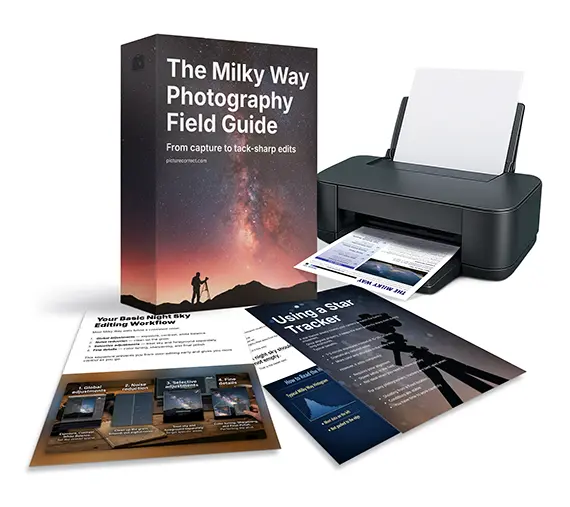
If you want a simple, field-ready way to master night photography, the Milky Way Photography Field Guide breaks it down step-by-step.
Right now, it’s part of our Clear Skies Sale—timed perfectly for the months when most photographers start planning their Milky Way shoots.
Deal ending soon: Milky Way Photography Guide 🌙 Clear Skies Sale
Like This Article?
Don't Miss The Next One!
Join over 100,000 photographers of all experience levels who receive our free photography tips and articles to stay current:




Leave a Reply