Photographers spend a lot of time trying to eliminate camera shake and motion blur.
For this exercise, you’re going to do the opposite.
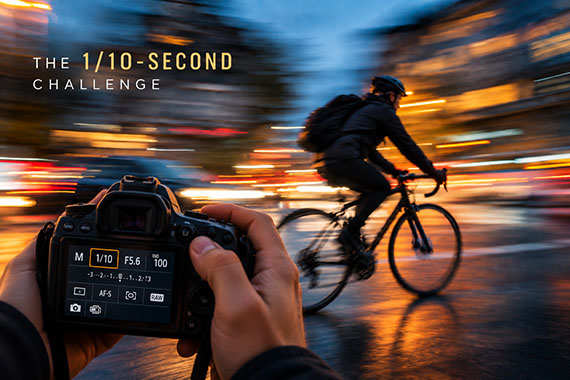
Set your shutter speed to around 1/10 of a second, leave the tripod at home, and photograph an entire session handheld.
The goal isn’t to make everything sharp. It’s to discover what happens when you deliberately allow movement into your photographs.
Why 1/10 Second?
At very fast shutter speeds, movement freezes. At several seconds, motion often becomes an obvious long-exposure effect.
But 1/10 second sits in an interesting middle ground.
It’s slow enough to show movement while still leaving recognizable shapes in the frame. Walking people develop blurred limbs, passing cars streak slightly, and moving water retains texture while gaining a sense of motion.
Three Ways to Try It
Set your camera to Shutter Priority (S or Tv) or Manual mode and choose approximately 1/10 sec.
First, try holding the camera as steadily as possible while your subject moves. Photograph pedestrians, cyclists, waves, traffic, pets, or trees blowing in the wind. The contrast between stationary and moving elements can be surprisingly effective.
Next, try panning. Follow a moving subject with your camera while taking the photograph. If your movement matches the subject, you may get a relatively sharp subject surrounded by a streaked background.
Finally, deliberately move the camera during the exposure. Sweep it vertically, horizontally, diagonally, or even rotate it slightly. This is known as intentional camera movement (ICM), and small changes in your movement can produce dramatically different results.
Don’t Look for Perfect Sharpness
When reviewing your photographs, resist automatically choosing the sharpest one.
Instead, ask:
Does the blur make the photograph more interesting?
A blurred hand can suggest action. Streaking scenery can communicate speed. Moving water can suddenly feel like it’s flowing.
Photography usually freezes a fraction of a second. This exercise asks you to show what happened during that fraction of a second instead.
Your Challenge
Take 30 photographs at roughly 1/10 second:
- 10 holding the camera still
- 10 while panning
- 10 using intentional camera movement
Then choose the photograph where movement contributes the most to the image—not necessarily the one that’s sharpest.
You may discover that a shutter speed you’ve spent years trying to avoid can become a surprisingly creative tool.
Like This Article?
Don't Miss The Next One!
Join over 100,000 photographers of all experience levels who receive our free photography tips and articles to stay current:






Leave a Reply