If you’ve spent any time planning Milky Way photography, you’ve probably heard the same advice:
Shoot during a New Moon.
It’s good advice—but it’s also a little oversimplified.
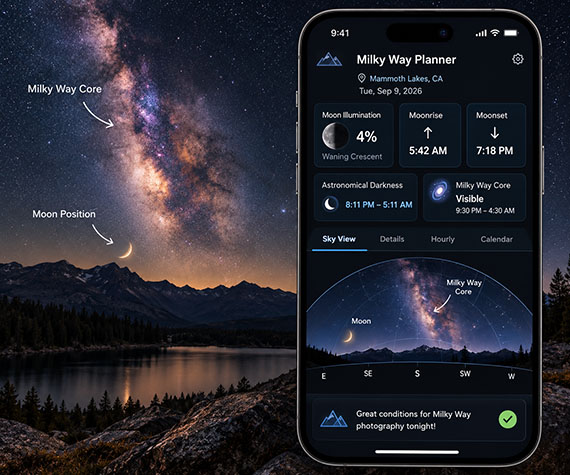
A New Moon creates wonderfully dark skies, but you don’t necessarily need to wait for the exact night of the New Moon to photograph the Milky Way. In fact, understanding when the Moon is actually in the sky can be more useful than simply looking at its phase.
Why the New Moon Is So Good
During a New Moon, the Moon is positioned roughly between Earth and the Sun. The illuminated side faces away from us, making the Moon essentially invisible at night.
That means one major source of natural light pollution disappears.
Under a genuinely dark sky, this can make a dramatic difference. The Milky Way’s faint dust lanes become easier to see and photograph, contrast improves, and you can capture more subtle detail in the galactic core.
But here’s the important part:
The Moon can’t brighten your photograph if it isn’t above the horizon.
Moonrise and Moonset Can Matter More Than Phase
Imagine the Moon is 40% illuminated—but it sets at 10:30 p.m.
If the Milky Way is in a good position at midnight, you could still have hours of beautifully dark sky.
The opposite can happen too. A relatively small crescent Moon positioned near the Milky Way can introduce more unwanted light than you might expect.
That’s why experienced Milky Way photographers usually check several things:
- Moon illumination
- Moonrise time
- Moonset time
- Moon position
- Milky Way core position
- Astronomical darkness
The goal isn’t necessarily “New Moon.”
The real goal is a dark sky during the hours when the Milky Way is where you want it.
How Many Nights Around a New Moon Are Good?
Fortunately, you don’t get just one opportunity each month.
The nights immediately before and after a New Moon are usually excellent for Milky Way photography because the Moon is only a thin crescent and spends much of the night below the horizon.
Depending on your location and shooting time, you can often find several excellent nights on either side of the New Moon.
That gives photographers a much larger window to work with—particularly important when clouds, smoke, haze, or work schedules ruin the “perfect” night.
Can Moonlight Ever Be Useful?
Absolutely.
A small amount of moonlight can illuminate mountains, trees, buildings, or other foreground subjects while leaving enough darkness to photograph the stars.
Instead of needing artificial light painting, the Moon can become an enormous natural softbox.
The trick is balance.
Too much moonlight—especially when the Moon is high in the sky or near the Milky Way—can reduce contrast and wash out faint galactic detail. But carefully timed moonlight can produce a beautifully illuminated foreground beneath a star-filled sky.
This Week Is a Great Time to Experiment
The September New Moon arrives September 10, creating an excellent dark-sky window around this week’s moonless nights.
And for photographers in the Northern Hemisphere, the timing is particularly valuable. We’re approaching the end of the prime season for photographing the bright Milky Way core during convenient evening hours.
So if skies are clear where you live, the next few nights are worth watching.
Don’t just check the Moon phase, though.
Check when the Moon rises and sets, when astronomical darkness begins, and where the Milky Way will be during those hours.
You may discover that your best Milky Way photography night isn’t technically the New Moon at all.
The perfect night is simply when the Milky Way is up, the Moon isn’t causing problems, and the sky is clear.
Like This Article?
Don't Miss The Next One!
Join over 100,000 photographers of all experience levels who receive our free photography tips and articles to stay current:



Leave a Reply