Tip 1: Miss the eyes and you’ve missed the shot. Getting the eyes in focus is key to capturing a photo of an animal. It’s human nature to look at the eyes. It’s how we determine emotion and how we connect. When I was in Homer, Alaska, I came across a moose on the move. Given it was early morning and the light was low I knew getting a fast shutter speed to freeze his movement would be tough, so I quickly adjusted my camera to lock the focus on his eyes, and took the shot. The majority of the picture was a bit blurry, but because the eyes are in focus, the shot was saved.
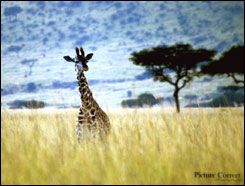 Tip 2: Use a telephoto lens. Getting closer to the action, yet staying a safe distance, is the key to photographing wildlife. By keeping your distance you allow the animal to be in their comfort zone and are more likely to get natural behavior. Safety is also a factor when photographing in the wild. Always keep at least 100 yards distance from wildlife, for your safety and for the well being of the animals. Another good use for a telephoto lens is a trick not many people know, which comes in very handy when photographing animals in the zoo that are behind fencing. If you move close to the fence (keep a safe distance) and use at least 100mm of your telephoto lens, focusing beyond the fence, with a wide aperture, you can “focus out” the fencing and take a photo of the subject with no wires! Now, there are some exceptions, such as, if the fencing is black you’ll have a much better chance of pulling this off. Regular chain link fence is gray and semi-reflective, which in the sunlight can cause a glare and is often too bright to focus out. I’ve also had some successes at trying different angles, so experiment for your best results. I often shoot with a Canon 100-400mm IS USM and a Canon 28-300mm IS USM. If you’re new to telephoto lenses, on a budget and not sure what to get, I suggest the Tamron 28-300mm or a Sigma 70-300mm. I’ve also had great results with the Sigma 50-500 which, as of this writing, I consider to be the best bang for the buck. These lenses all work with teleconverters of 1.4x and 2.0x so you can easily extend your reach even further, often while keeping auto-focus (with Canon L lenses, a minimum aperture of 4.0 or less will support auto-focus. Above that a manual focus is your only option.)
Tip 3: Use a wide aperture. Learning the effects of adjusting your camera’s aperture will go a long way toward improving your photographs, especially in portrait style shooting. In a photo of a grazing elk I shot in Yellowstone, I chose a very wide aperture to blur out a potentially busy background and bring attention to the subject instead. As you learn to control your camera you’ll also find that adjusting your aperture will have a direct effect on your shutter speed. This will prove especially helpful when shooting in the early mornings and late evenings, when animals are typically most active and the light is warm and muted.
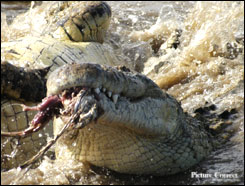 Tip 4: Adjust your shutter speed to stop/show the action. When animals are on the move you need to decide quickly on the type of shot you want to take. If you want to freeze the action, you’ll need to shoot at 1/500 or faster and depending on light, that can be tricky. One option, if you’re shooting digital, is to adjust up your ISO, which will make your sensor more sensitive to light and give you that needed boost in shutter speed. Now, if you want to give a sense of motion to your image, try shooting with a shutter speed of 1/4 to 1/8 and pan your camera with the animal. Pan steady and remember, keep the eye in focus if you can! For best results, pick backgrounds that are uncluttered and simple, as this will make the subject standout in the image.
Tip 5: Use a flash to fill in shadows. It may sound odd, but using a flash outside on a bright sunny day actually makes a lot of sense. In this situation, you’re not using the flash to illuminate the subject, as you would in a dark setting, but rather to fill in the shadows and provide detail where harsh shadows would otherwise be heavy and dark. It’s important to use flash wisely and here are a couple of other suggestions:
Be conscious of the animal and whether flash will scare them and,
There are times where your only shoot is through glass — using a flash behind glass will ruin your shot. The glass will reflect the light back at the camera and you shouldn’t be surprised if all you get is a big white picture!
Tip 6: Plan for the best light. There’s nothing like a cloudy day to provide soft, even light for wildlife photography. Clouds act like a giant diffuser to the sun, spreading the light out evenly and taking away harsh shadows that are created by a bright, sunny day. Of course, a cloudy day has its challenges as well, such as lower light, which will force you to adjust ISO and shutter speed settings for stopping action and getting sharp, in focus images.
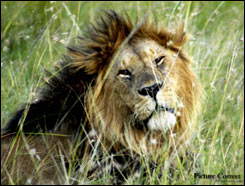 Tip 7: Composition – Framing your shots. Some simple framing advise can go a long way toward improving an image, and for those who are computer savvy, a little trick called cropping (software technique to cut a photo) can help improve composition that wasn’t quite right at the time the photo was taken. The best way to think about composition is to picture a tic-tac-toe grid in the view finder of your camera (I’ve seen some new cameras that come with this as a feature you can turn on!) and use that grid to organize your shots. There is no hard rule, but the general theory behind good composition is that your subject lies in one of the crosshairs of the grid. Setting up your shot to lead the eye is also a good example of composition.
Tip 8: Shoot with two eyes. This is a tip I’m sharing here, but often have a hard time remembering myself. I can’t tell you how many shots I’ve missed because I didn’t see the action coming. By keeping both eyes open you’ll see the subject in the viewfinder and you’ll also see what’s going to happen next.
Tip 9: Anticipate behavior. This tip goes well with Tip 8, shoot with both eyes, because anticipating behavior is often key to capturing a rare moment, action and unique situations. Panning the camera to follow an animal can be a tiring process, so often I’ll study the animal’s behaviors watching for a pattern and then use some anticipatory shooting, and a little luck, to hopefully capture that perfect moment.
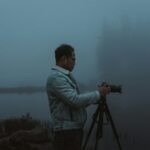
Tip 10: Use a tripod. Using a tripod is one of the best things you can do to improve your photography, and wildlife is no different. By mounting your camera to a tripod you reduce camera shake, which is usually the cause of blurry photos. To take this a step further, I use a shutter release cable, which eliminates the need to touch the camera while snapping shots and thus removes almost all potential for camera shake.
 Bonus Tip: Shoot. Shoot. Shoot. This tip is a no-brainer for those of us who shoot digital. Shooting digital is cheap — technology is advancing so quickly that, as of this writing, a 4 gigabyte memory card is selling for less than $100 and you can get A LOT of photos on a 4 gig memory card. The bottom line of this tip is take photos….a lot of photos. Don’t be shy. I often take multiple photos of the same scene or subject and then later choose the best from the group. This is also a great way to learn; by adjusting your camera between shots you can experiment and see the results of different settings of your camera. And, don’t sweat the details of trying to remember which photo had which settings…another great thing about shooting digital is something called EXIF (Exchangeable Image File Format). EXIF data is written to every photo so that later, upon review, you can see every setting your camera used to take that image.
About the Author
Stephen Oachs spends every chance he gets looking through the viewfinder of his cameras. He is an accomplished nature photographer with an impressive gallery of stunning wildlife shots. Visit his photo journal at www.stephenoachs.com. Read more about him at his blog, stephenoachsphotography.blogspot.com. When not taking photographs, Stephen’s day job is spent as technical director of VisiStat.com, a leading next generation Web Analytics service that specializes in real-time Website Performance Management.
Like This Article?
Don't Miss The Next One!
Join over 100,000 photographers of all experience levels who receive our free photography tips and articles to stay current:




Leave a Reply