Heads Up, Night Sky Photographers: The Leonid meteor shower is expected to peak overnight on November 17–18, 2026, with up to 15 meteors per hour under ideal conditions. The Leonids are known for their exceptionally fast, bright streaks and occasional fireballs. The best photography opportunities will be after midnight and before dawn, when the Moon has set and the skies are darker.
You’ve spent hours photographing the night sky, and while reviewing your images, you discover a bright streak among the stars. Did you capture a shooting star, or was it simply a passing satellite?
At first glance, the two can look remarkably similar. However, there are several clues that can help you identify what your camera captured.
Related: Get a head start on Black Friday savings with the Milky Way Photography Guide 🎁 Early Black Friday Special
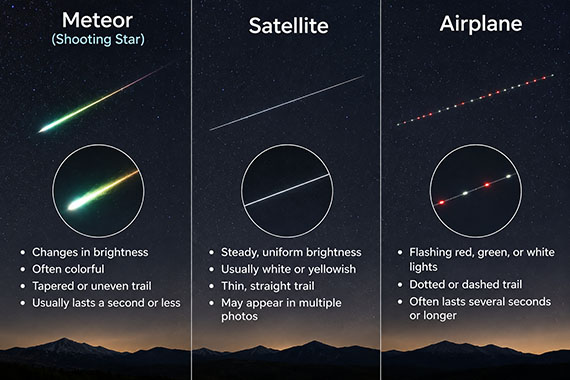
1. Look at the Shape of the Trail
Meteors often produce streaks that change in thickness and brightness along their length. They may have tapered ends, sudden bursts of brightness, or an irregular appearance as they burn up in Earth’s atmosphere.
Satellites typically produce thinner, straighter, and more uniform trails as they reflect sunlight while moving across the sky.
2. Look for Color
Meteors can display striking colors, including green, orange, yellow, and blue. These colors result from the interaction of the meteoroid and the surrounding atmosphere as it heats up.
Satellite trails are generally white or slightly yellowish, although exceptions exist.
3. Check the Previous and Next Photos
One of the most reliable ways to distinguish between meteors and satellites is to examine consecutive exposures.
A meteor typically flashes across the sky in a fraction of a second to a few seconds, appearing in just one photograph. A satellite moves much more slowly and may appear across several consecutive images.
If the streak continues in your next exposure, there’s a good chance you’ve photographed a satellite.
4. Consider the Direction of the Streak
During a meteor shower, meteors appear to originate from a particular region of the sky known as the radiant.
If you mentally extend the streak backward and it aligns with the shower’s radiant, it may be a meteor associated with that shower. Satellites have no such relationship to the radiant.
5. Watch Out for Satellite Flares
Some satellites briefly become extremely bright when their reflective surfaces catch sunlight. These events, known as satellite flares, can closely resemble meteors in photographs.
A flare often produces a smooth, symmetrical increase and decrease in brightness, whereas a meteor may exhibit more abrupt and irregular changes.
6. Don’t Forget About Airplanes
Aircraft can also leave bright streaks across your night sky photographs. However, their flashing navigation and anti-collision lights often create dotted or dashed patterns, sometimes accompanied by parallel red or green streaks.
Final Thoughts
Not every streak in your night sky photographs is a shooting star. Satellites, aircraft, and even satellite flares can create convincing lookalikes.
The next time you photograph a meteor shower, take a closer look at the shape, color, brightness, and duration of each streak. No single clue is definitive, but together they can help you identify what you’ve captured.
And remember to keep your camera shooting continuously. The most spectacular meteor of the night might appear when you least expect it.
For Further Training on Night Photography:
If you want a simple, field-ready way to master night photography, the Milky Way Photography Field Guide breaks it down step-by-step.
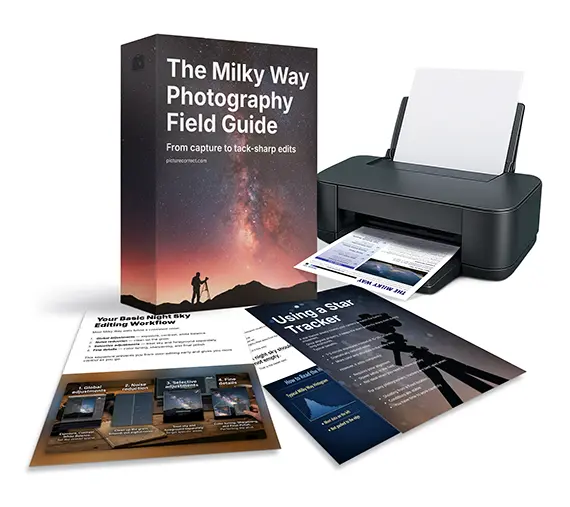
Our Early Black Friday Special is already underway! It’s a great opportunity to save on this comprehensive guide and learn how to capture sharper stars, stunning Milky Way images, and incredible night sky photographs.
Limited-time offer: Milky Way Photography Guide 🎁 Early Black Friday Special
Like This Article?
Don't Miss The Next One!
Join over 100,000 photographers of all experience levels who receive our free photography tips and articles to stay current:




Leave a Reply