Autumn is one of the most colorful times of year for photography, but all that color can actually make composition more difficult. When every tree, branch, and patch of ground is competing for attention, it’s easy to end up with a busy photograph that lacks a clear subject.
Here’s a simple creative exercise: find one interesting autumn leaf and build an entire photograph around it.
The One-Leaf Composition Challenge encourages you to slow down, simplify your frame, and explore how much visual impact a single subject can have. You don’t need a spectacular landscape or expensive equipment. Just one leaf, a little creativity, and an eye for composition.
Also remember that an 🍂 Autumn Sale for the Cheat Sheets on all the Compositional Elements is ending soon!

Photo captured by Nathan Gubler
1. Find a Leaf With Character
Not every leaf needs to be perfectly shaped or brightly colored. In fact, imperfections often make a subject more interesting. Look for unusual shapes, curled edges, contrasting colors, visible veins, or small signs of decay.
A partially yellow leaf with a deep red edge might be more compelling than a perfectly symmetrical orange one. The goal is to find something that gives the viewer a reason to look closer.
2. Simplify the Background
With only one leaf as your subject, the background becomes especially important. A cluttered background can easily overwhelm a small subject, so look for surfaces that provide contrast without competing for attention.
Try photographing your leaf against:
- Dark pavement or weathered wood
- Smooth stones or a moss-covered rock
- A patch of green grass
- A simple, neutral-colored surface
Pay attention to both color and texture. A red leaf against a green background creates strong color contrast, while a yellow leaf on dark stone emphasizes shape and detail.
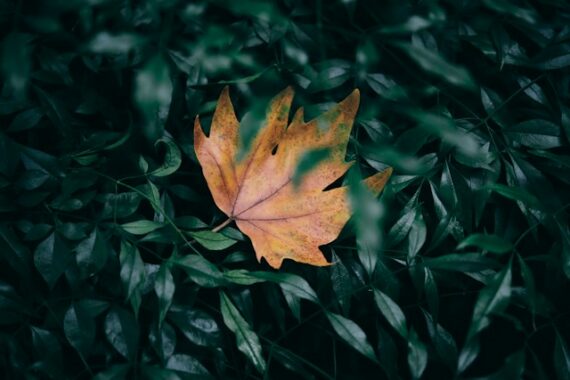
Photo captured by seelean
3. Experiment With Negative Space
One of the most effective ways to photograph a single leaf is to leave plenty of empty space around it.
Instead of filling the entire frame, place the leaf off-center and allow the surrounding area to become part of the composition. This creates a sense of simplicity and gives the viewer’s eye somewhere to rest.
Try this: Position your leaf in the lower third of the frame, leaving the upper two-thirds relatively empty. Then take another photo with the leaf perfectly centered. Compare how the two compositions feel.
4. Change Your Perspective
A small change in camera position can completely transform your photograph.
Photographing straight down emphasizes the leaf’s shape and creates a graphic, almost abstract composition. Shooting from ground level can make the leaf feel larger and more prominent, especially when the background falls softly out of focus.
You can also move closer to highlight veins, textures, and curled edges. A macro lens is helpful, but even a smartphone can capture interesting details.
5. Use Light to Reveal Texture
Autumn leaves are especially interesting when light passes through them. Their thin surfaces can glow with rich color, revealing intricate patterns that might otherwise go unnoticed.
Try backlighting your leaf with low afternoon sunlight, or use soft side lighting to emphasize its texture.

Photo captured by Wei Feng
Avoid assuming that bright, direct sunlight is always best. Overcast conditions can produce beautifully even illumination, particularly when you’re photographing subtle colors and details.
6. Make Five Different Compositions
Here’s the actual challenge: photograph the same leaf five different ways without changing your subject.
- Minimalist: Use plenty of negative space.
- Symmetrical: Center the leaf and emphasize its shape.
- Close-up: Fill the frame with its texture and details.
- Color contrast: Find a background that makes its color stand out.
- Creative perspective: Shoot from an unexpected angle.
Try to make each photograph feel distinctly different. You may be surprised by how many compositions you can discover using such a simple subject.
What This Exercise Really Teaches
The One-Leaf Composition Challenge isn’t really about leaves. It’s about learning to recognize the visual possibilities in ordinary subjects.
By limiting yourself to a single leaf, you’re forced to pay closer attention to placement, background, light, perspective, and the edges of your frame. These are the same decisions that determine whether a landscape, portrait, or street photograph succeeds.
The next time you’re out photographing autumn colors, resist the temptation to capture everything at once. Find one leaf that catches your attention, slow down, and see how many different ways you can tell its story.
Sometimes the strongest autumn photograph isn’t an entire forest of colorful trees. It’s just one leaf, thoughtfully composed.
For Further Training on Composition:
Do you ever have trouble remembering all the elements of composition? These popular Composition Cheat Sheets have you covered. With clear, concise information on all the essential elements of composition, you’ll never be unprepared again. They are currently 81% off today for an 🍂 Autumn Sale if you want to check them out.

Composition Cheat Sheets (see all the elements covered)
The perfect companion for any photographer. Print one out whenever you need it. These cheat sheets consolidate crucial composition-related information, allowing you to concentrate on what truly matters – composing striking photographs.
Autumn sale ending soon: The Composition Cheat Sheets at 81% Off
Like This Article?
Don't Miss The Next One!
Join over 100,000 photographers of all experience levels who receive our free photography tips and articles to stay current:






Leave a Reply