In a previous article, I discussed shooting with the light at the subject’s back, creating a “halo” lighting pattern. Aside from being a particularly stunning light pattern, it automatically eliminates one of the biggest problems we have as photographers: squinting and closed eyes.
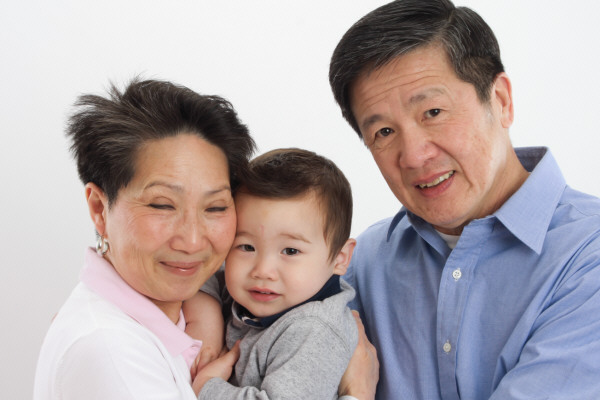
“nana’s eyes closed again – close up” via jenny cu
With the light coming from the rear, the face is in shadow, and with no direct light, there’s no need for the model to squint. But what if we want a more conventional lighting pattern and want to shoot with the light coming from the front or coming from the side?
Here are a couple tips to help avoid the problem.
First, we know that the light from the sun is more beautiful the closer it gets to sundown. The harsh white of midday turns into a nice golden glow.
Good news! It is not only prettier to look at, it’s easier to look at, too. So the first step in getting rid of squinting is to shoot closer to sundown.
Second, for some subjects, it’s almost impossible for them to look toward the sun. They have overly sensitive eyes and will almost always be squinting.
I don’t know why, but for some reason people with lighter colored eyes—blue eyes, green eyes—seem to be more sensitive to light.
Here is a tip that can help. This should only be used in cases where nothing else is working, as it’s difficult for the subject to pull this off and look natural, but it’s better than squinting.
As photographers, we’re constantly counting to three and shooting. This is generally done to capture a smile, but it can also be done to avoid squinting.
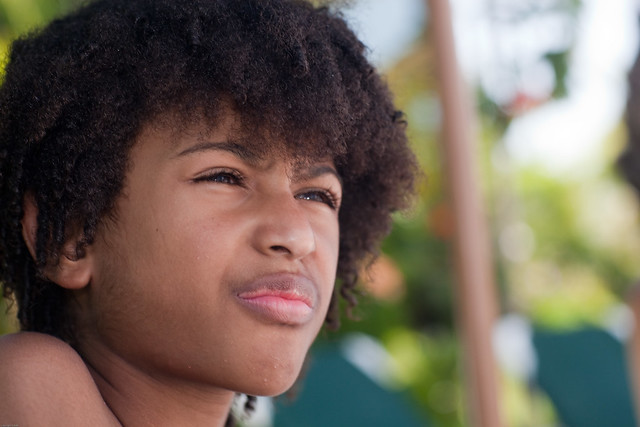
“Shaggy Squint” captured by Vox Efx
Have your subject posed the way you want them and then have them close their eyes. You count to three, and they open their eyes and smile. They only have to have their eyes open for a second or so, and if they can look natural it can be the difference between a truly great shot and another one for the garbage.
Opening the eyes and looking natural—while knowing the sun is going to get to you—can take a bit of practice. Take the time to run through it a few times and not only will you get better shots, but every photographer that ever shoots them in the future will benefit as well.
Third, some subjects aren’t particularly sensitive to the light, but to a flash. They tend to squint in anticipation of the flash going off.
The obvious solution is not to use a flash, but sometimes we need one, so here is an idea: don’t aim the flash at the subject. Bounce it off the ceiling or an adjacent wall.
Yes, I know there’s no ceiling outside, but there are plenty of adjacent walls. (The side of a truck will do the job!) Just be careful not to use a colored wall because that will put a colored tint in your photo.
By the way, bouncing a flash is almost always the preferred method, not just with “squinters.
Another idea is to use a reflector. That way you can bounce more light into the subject and may not need a flash. Or you can use it as your bounce “wall.”
You can finally eliminate closed and squinting eyes from your photos!
About the Author:
Dan Eitreim writes for ontargetphototraining.com. He has been a professional photographer in Southern California for over 20 years. His philosophy is that learning photography is easy if you know a few tried and true strategies.
Like This Article?
Don't Miss The Next One!
Join over 100,000 photographers of all experience levels who receive our free photography tips and articles to stay current:





The reason lighter eyes such as blue/grey/green are more responsive/sensitive is due to a lower amount of melanin (darker eyes like brown=more melanin) which protects the eyes from the sun just as african americans/asians have better skin protection than for say someone of irish ancestry
If you are going to have people blink, then take a picture as their eyes open, please make sure you do several shots. I saw a photographer do this that was hired to take team photos of youth football players. The photos turned out terrible. She had only taken 2 or 3 shots, and when many of the kids opened their eyes, they opened them really wide which just looked goofy.
When you tell some people, especially kids, to close their eyes, they may squeeze them shut. Especially if they are facing the sun. Then, when they open them, they still have little wrinkles around their eyes from squeezing them shut.
Just be smart and do not have people face the sun, and always deflect the flash, and take many, many photos.
A couple more hints:
1) When taking portraits outside, shoot with the subjects backs to the sun (yes, you do have to be concerned about flare down the lens). Expose for the faces of your subjects, you may well get bleached highlights depending on how bright the sun is. Try to have something in the background which is also in shade (a wall, a building, trees, etc.) so that the background isn’t totally bleached out. This also gives something to render in the out of focus area of the image. Look at the work of wedding photographers, they will almost always do the group shot photos with the subjects backs to the camera. The subjects don’t squint and you don’t have a nasty shadow over only half the face (if the sun was to the side for example) and you get a nice backlit effect too.
2) If you’re using flash and you see someone blinking a lot, try turning off TTL and use manual flash settings. Some people react to the pre-flash from TTL mode which causes them to blink just as the main flash fires (fire your flash in TTL mode and you can see the pre-flash and the main flash). People do blink when a flash fires, but the flash travels at the speed of light and no human that I know can react that quickly – it is the pre-flash they react to. Manual flash does not use pre-flash to gauge the exposure (but you may need to shoot a test shot or two to get the flash setting you need). This tip works whether using direct or bounce flash, indoors and outdoors.
Another way is maybe take several in a row. (hold the shutter open)
Great timing with this post, ran across this issue this past weekend on a wedding shoot. Very little shade to be had.
I just read this article and while I’ve been around long enough to have dealt with the issues here, it reminded me of something I do for people, like everyone in my family – has naturally squinty eyes.
I teach thee people to open their eys WIDE and then when I say “2” just relax. What it does it it keeps the eye wide for a second or two and the natural squint ins’t there.
Try it, it works great!