Long exposure photography allows you to capture the world in ways the human eye cannot see. Waterfalls become silky ribbons, clouds streak across the sky, and passing cars leave brilliant trails of light.
The secret is keeping your camera’s shutter open longer than usual. But which settings should you use? Here’s a quick cheat sheet to get you started.
Reminder: the Early Black Friday Special is now underway for the Long Exposure Photography Field Guide – 70% Off!
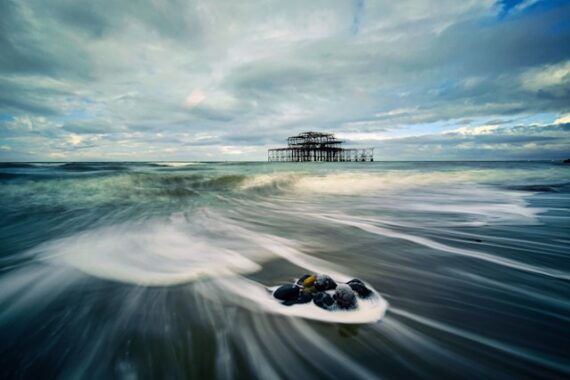
Long exposure captured by Martin Bullimore
1. Basic Camera Settings
For most daytime long exposures, start with these settings:
- Shooting mode: Manual (M)
- ISO: 100 or your camera’s base ISO
- Aperture: f/8–f/11
- Shutter speed: 1–30 seconds, depending on the subject
- Focus: Establish focus, then switch to manual focus
- File format: RAW
- Shutter release: 2-second timer or remote release
Use a sturdy tripod to keep stationary elements sharp while moving subjects become blurred.
2. Shutter Speed Cheat Sheet
Different subjects require different exposure times. Use these settings as a starting point:
- Moving people: 1/4–2 seconds for ghostly figures.
- Waterfalls: 1/4–2 seconds for silky flowing water.
- Ocean waves: 1/2–2 seconds to capture textured movement.
- Seascapes: 15–60 seconds for misty, smooth water.
- Moving clouds: 30–120 seconds for streaking clouds.
- Car light trails: 5–30 seconds for continuous light trails.
- Fireworks: 2–8 seconds to capture full bursts of light.
- Milky Way: 5–20 seconds for stars with minimal trailing.
- Star trails: 15–30 seconds per frame, with multiple images stacked together.
These are starting points, not strict rules. Experiment with different shutter speeds to find the effect that best suits your composition.
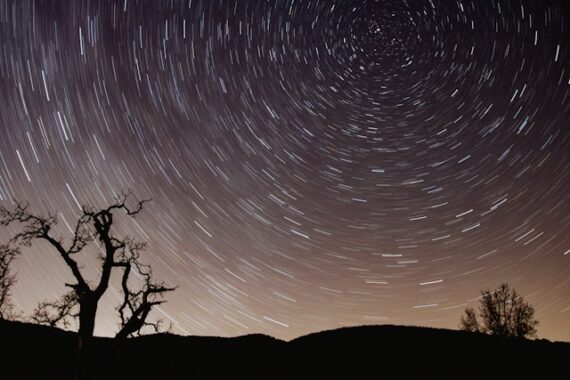
Photo captured by Caleb Woods
3. Choosing the Right ND Filter
During daylight, a neutral density (ND) filter reduces the amount of light entering your lens, allowing you to use slower shutter speeds without overexposing your image.
- 3-stop ND filter (ND8): Ideal for waterfalls and streams.
- 6-stop ND filter (ND64): Great for waves and flowing water.
- 10-stop ND filter (ND1000): Perfect for smooth seascapes and streaking clouds.
- 15-stop ND filter (ND32000): Useful for extreme daytime long exposures.
For example, if your correct exposure without a filter is 1/125 second, adding a 10-stop ND filter extends your shutter speed to approximately eight seconds.
4. Nighttime Long Exposure Settings
At night, you generally won’t need an ND filter. However, your settings will vary depending on your subject.
Cityscapes and light trails:
- ISO: 100–400
- Aperture: f/8–f/11
- Shutter speed: 5–30 seconds
Milky Way photography:
- ISO: 1600–6400
- Aperture: f/1.4–f/2.8
- Shutter speed: 5–20 seconds, depending on focal length
5. Quick Tips for Better Results
- Avoid f/22: Extremely small apertures can reduce sharpness through diffraction.
- Check your histogram: Don’t rely solely on your camera’s LCD to judge exposure.
- Include stationary objects: Sharp rocks, buildings, or trees create contrast with blurred movement.
- Use Bulb mode: For exposures beyond your camera’s normal shutter speed limit.
- Experiment with shorter exposures: Longer isn’t always better. Sometimes retaining texture in moving water creates a more compelling photograph.
Final Thoughts
Long exposure photography is a powerful way to transform ordinary scenes into extraordinary images. The next time you’re photographing moving water, try capturing the same composition at 1/4 second, two seconds, and 30 seconds.
You’ll quickly discover how shutter speed can become one of your most powerful creative tools.
For Further Training:
Some of the most breathtaking photographs reveal something the human eye can never see: the movement of time. Our new Long Exposure Photography Guide & Cheat Sheets (currently 70% off for our Early Black Friday Special) walks you through everything from choosing ND filters and camera settings to photographing waterfalls, oceans, clouds, and nighttime scenes.

You’ll also learn how to avoid common mistakes and edit your long exposure photographs for professional-looking results.
Get a head start on Black Friday savings and discover what your camera is truly capable of capturing.
Early Black Friday Special: Get the Long Exposure Photography Guide at 70% Off
Like This Article?
Don't Miss The Next One!
Join over 100,000 photographers of all experience levels who receive our free photography tips and articles to stay current:

Leave a Reply