If you’ve ever switched to Manual mode and thought, “Exposure compensation shouldn’t matter anymore… right?” — you’re not alone.
On the surface, exposure compensation feels like an Auto-mode crutch. Something designed for cameras that are making decisions for you. And since Manual mode is all about control, it seems logical that exposure compensation would become irrelevant.
But here’s the surprise:
Exposure compensation still matters in Manual mode — just not in the way most people think.
Once you understand what it’s actually doing, a lot of exposure confusion disappears.
Related: Ready to make serious progress with your camera? PictureCorrect Premium works like a photography accelerator — structured, practical, and the March enrollment special intro offer is ending soon! ⏰
What Exposure Compensation Really Does
Exposure compensation doesn’t magically brighten or darken photos on its own.
What it actually does is tell the camera’s metering system:
“I want this scene brighter or darker than what you think is correct.”
The key thing to understand is this:
The meter never turns off.
Even in Manual mode.
Your camera is always evaluating light and comparing it to its idea of a “neutral” exposure — usually middle gray.
Manual Mode ≠ Meter-Free Mode
Manual mode gives you control over:
- Aperture
- Shutter speed
- ISO
But the camera is still:
- Measuring the scene
- Displaying a meter
- Judging whether your settings match its baseline exposure
That meter scale you see in the viewfinder?
That’s where exposure compensation comes into play.
When you dial in exposure compensation, you’re not changing the exposure directly — you’re shifting the meter’s zero point.
So What Changes in Manual Mode?
That depends on how your camera is set up.
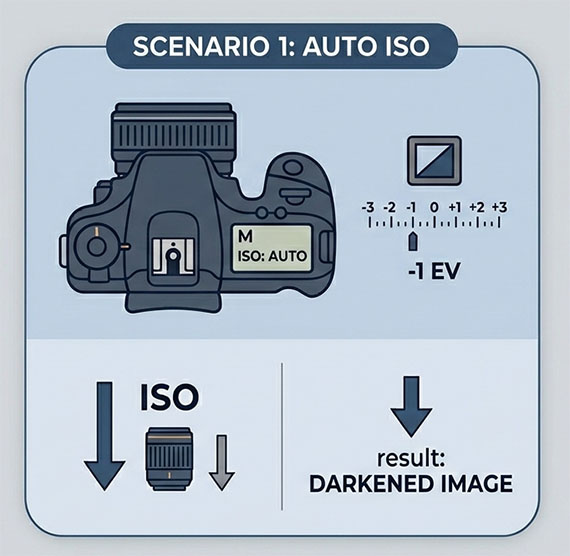
Case 1: Manual + Auto ISO (Very Common)
This is where exposure compensation matters a lot.
In this setup:
- You choose aperture and shutter speed
- The camera adjusts ISO automatically to match the meter
Exposure compensation tells the camera:
“Use a higher or lower ISO than you normally would.”
So:
- +1 EV → Camera raises ISO to brighten the image
- –1 EV → Camera lowers ISO to darken the image
If you ignore exposure compensation here, the camera will faithfully expose scenes exactly how its meter sees them — even when that’s not what you want.
Case 2: Full Manual (Aperture, Shutter, ISO All Fixed)
In true full manual:
- Exposure compensation does not change the exposure automatically
But it still:
- Shifts where “0” sits on the meter
- Changes how the camera evaluates correct exposure
This matters because the meter is still your reference point.
If you dial in +1 EV, your camera is now telling you:
“What used to be –1 is now normal.”
That’s incredibly useful when:
- Shooting snow, sand, or bright skies
- Photographing dark scenes
- Working under consistent lighting
Instead of constantly ignoring the meter, you recalibrate it to match reality.
Why This Confuses So Many Photographers
Most explanations skip one crucial idea:
Exposure compensation affects the meter — not just the exposure.
If you think of it as:
- “Brighten photo” / “Darken photo”
…it feels unnecessary in Manual mode.
If you think of it as:
- “Redefine what the camera considers correct”
…it suddenly makes perfect sense.
Real-World Example
Imagine photographing a white wall.
The camera meter wants to make it gray.
So you:
- Dial in +1 or +2 EV
- Now the meter agrees that “brighter than gray” is correct
You can shoot confidently without second-guessing every frame.
This is especially powerful when you’re working quickly and don’t want to fight the meter on every shot.
The Big Takeaway
Exposure compensation isn’t an Auto-mode training wheel.
It’s a communication tool between you and the camera’s brain.
- Manual mode gives you control
- Exposure compensation gives you context
Together, they let you work faster, more intentionally, and with fewer surprises.
Why This Matters for Learning Manual Mode
Most people struggle with Manual mode not because it’s hard — but because they’re constantly arguing with their camera.
With the PictureCorrect Premium newsletter, this is exactly the kind of thing we train through:
- Short, focused explanations
- Controlled shooting exercises
- Real-world scenarios that force understanding, not memorization
If Manual mode has ever almost made sense but still felt inconsistent, this is the missing layer.
Deal ending soon: March Enrollment Special Intro Offer
Like This Article?
Don't Miss The Next One!
Join over 100,000 photographers of all experience levels who receive our free photography tips and articles to stay current:

Leave a Reply